Photo credit: Marnely Murray By: Phyllis M. Cahaly, CMD, Director of Partnership Marketing, Massachusetts Office of Travel & Tourism Do you love collecting rocks and minerals? Then you just might be a ‘rock hound!’ The term ‘rockhounding’ was first coined about 110 years ago in 1915, particularly in the western part of the country, […]
Photo credit: Marnely MurrayBy: Phyllis M. Cahaly, CMD, Director of Partnership Marketing, Massachusetts Office of Travel & Tourism
Do you love collecting rocks and minerals? Then you just might be a ‘rock hound!’ The term ‘rockhounding’ was first coined about 110 years ago in 1915, particularly in the western part of the country, as amateur geologists sought out, polished, and collected various types of stones. By the 1930s, rockhounding had become an established hobby throughout the country and interested rockhounds set out to scoop up their fair share of agate, jasper, and other precious stones, all free for the taking.
Serious rockhounds, especially in California, wandered through desolate quarries and fields searching out any kind of unusual gems which might be turned into jewelry. Some of these rockhounds would venture to set up little rock shops around popular roads where vacationers might visit to purchase a souvenir along the way.
By the 1960s, more than 3,000 rock shops and clubs had been established as this hobby continued to take flight. By then, The Bureau of Land Management estimated that there were more than three million American rockhounds in the county.
In Massachusetts, we welcome all rockhounds to come discover some of our unique treasures. Other than our most historic rock, Plymouth Rock, notwithstanding, did you know that we even have some official state rockhound symbols?
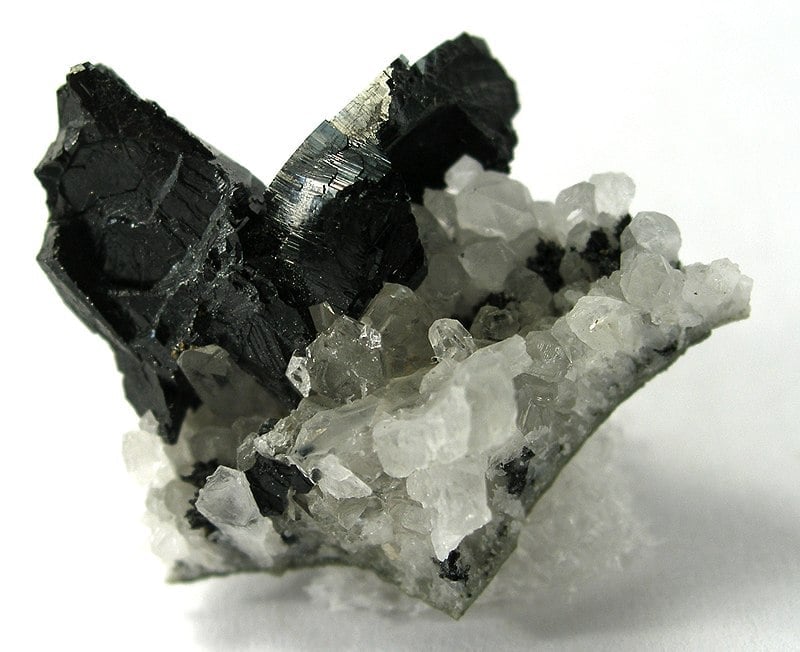
State Mineral: Babingtonite
Babingtonite, photo courtesy of Rob Lavinsky
While the Commonwealth contains few precious mineral resources, it is one of the rare locations in the world where Babingtonite is found. This jet-black material, with a brilliant submetallic luster, is the finest quality found in America. The General Court named it the official state mineral on April 24, 1981.
State Rock: Roxbury Puddingstone
The Roxbury Puddingstone, sometimes called Roxbury Conglomerate, became the state rock on May 23, 1983.
State Gemstone: Rhodonite
Rhodonite is the most beautiful gem material found in the state. It varies in hue from light pink to deep rose/reddish pink and is associated with black manganese. It was adopted in 1979 as the state gem.
State Fossil: Dinosaur Tracks
Dinosaur tracks, photo courtesy of Beneski Museum of Natural History, Amherst, MA
The Dinosaur Tracks in Granby, Massachusetts, were made over 200 million years ago. The prints of a theropod dinosaur, fifty feet in length from head to tail (the first record of a theropod of such magnitude), were found and were made the state fossil in May 23, 1980.
Additionally, some of the most commonly found gemstones and minerals in Massachusetts include garnet, agate, jasper, amethyst, and smoky quartz. We have a variety of interesting places for you to dig around in and explore, like private and public quarries, mountains, and mines. Many of our beaches offer scenic, shoreline rockhounding adventures too, just be sure to check the Massachusetts rules and regs first and remember to obtain permission to collect on private property.
Grab your picks, chisels, and collecting bucket or bags and get hounding, and don’t forget your safety goggles!
Western Massachusetts
At the Hampden Quarry in West Springfield, look for datolite, babingtonite and prehnite. Franklin County is known as one of the best areas of Massachusetts for rockhounding, especially around the Deerfield River where you’ll find jasper and agate. Rhodonite, the Commonwealth’s official state gemstone, can only be found in Plainfield, specifically at the Betts Rhodonite Mine (fee and reservations required), and the entire region is a great spot to search for garnets around stream gravels and rocky openings. Be sure to visit the Northfield Mountain Recreation Area in Erving to search for high-quality garnets.
Central Massachusetts
At the Bolton Lime Quarry in Worcester, look for large pink scapolite crystals and tourmaline. Around Rollstone Hill in Fitchburg, look for pegmatite containing beryl and in Sterling, search for chalcopyrite and siderite.
Cape Cod and the Islands
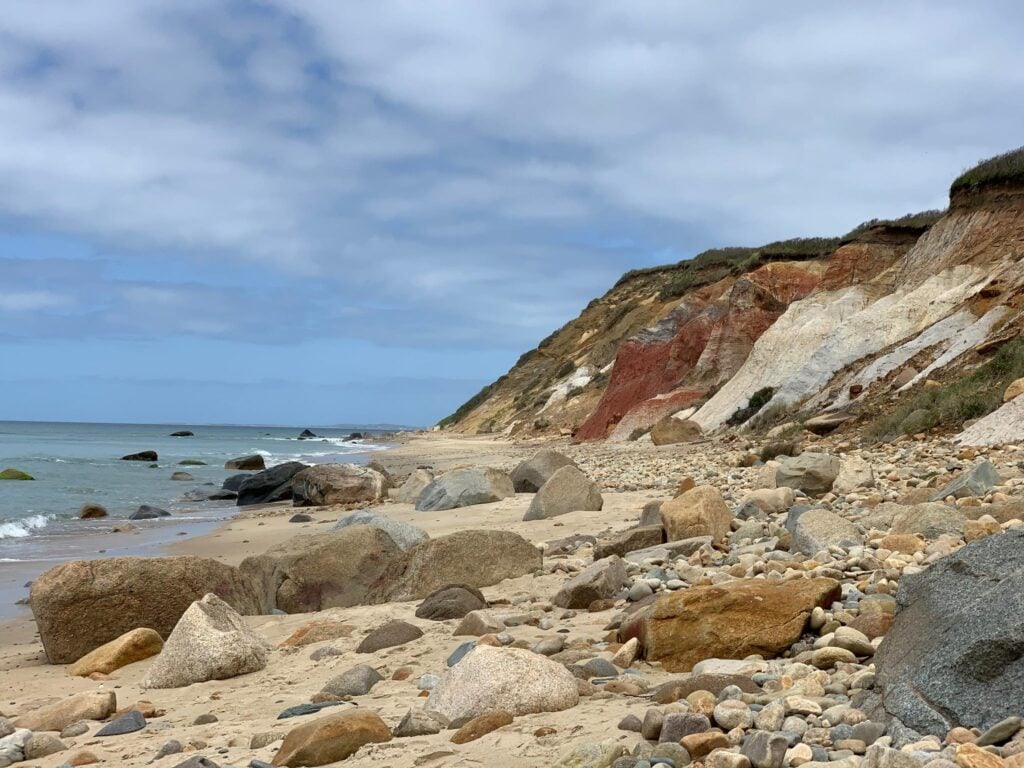
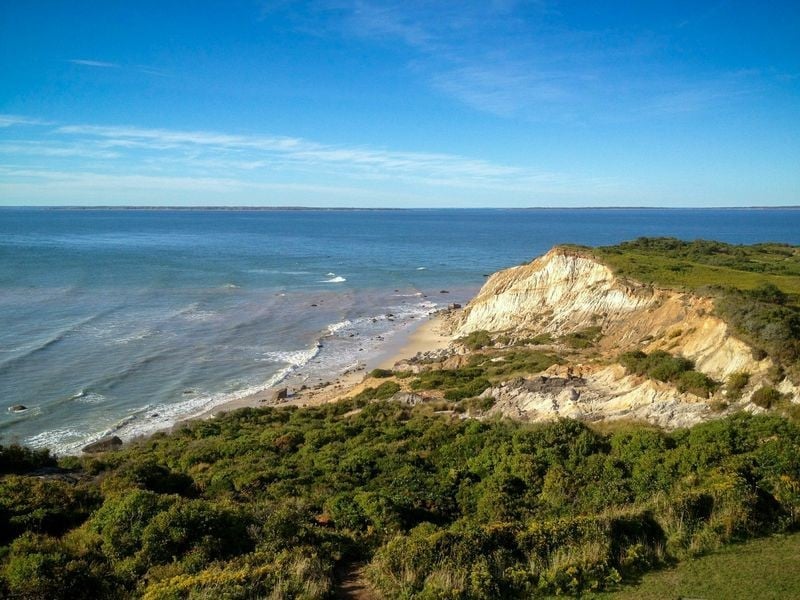
Aquinnah Cliffs
The beaches northwest of Sandwich are your best bet to search for jasper. For samples of alum and amber, check out the Aquinnah Cliffs on Martha’s Vineyard and always be on the lookout for beach areas featuring green sand.
North of Boston
In Dracut, look for quartz crystals, opal, kyanite and diopside at the PJ Keating Quarry. You can also find sodalite, chalcopyrite, galena and jaspers around the Essex County area. The Babson Farm Quarry, located at the tip of Cape Ann in Rockport, offers great walking trails along the scenic coastline.
South of Boston
Around the Middleborough area, you’ll search for agate and chalcedony samples. Many areas around Plymouth County and especially the beaches near Cohasset and Marshfield are great locations to look for jasper.
Greater Boston
In the Greater Boston area and eastern Massachusetts, it’s recommended that you search around the nooks and crannies in the sand and graveled areas of ocean beaches. This is your best bet for finding jasper all along the Massachusetts coast from Boston to Gloucester.