New England was one of the first places in America to be substantially settled by Europeans; many of the earliest settlers in the area were deeply religious people, often seeking freedom of worship. It’s no surprise that this region is dotted with some of the oldest Christian religious sites in the United States. From New Bedford to Newburyport, the churches of Eastern Massachusetts are not likely to disappoint. We’ve curated a few spots to start exploring – be sure to check each church’s website for the most up to date visiting days/hours.
Beginning south of Boston, this area stretching from the city to Cape Cod is home to dozens of churches that date as far back as the colonial era, including two that were built in the 17th century.
The city of New Bedford, approximately forty miles south of Boston, is a great place to start a tour of the region. This port, which played a major role in the early American whaling industry, is home to Seamen’s Bethel Chapel (1832). This church has served the local maritime community for nearly two centuries, and is closely associated with Herman Melville’s immortal novel, Moby-Dick. Fans of the book come to Seamen’s Bethel to marvel at the pulpit, built to look like a ship’s bow, and sit in the pew where Melville once sat.

An hour’s drive from New Bedford brings visitors to the Cape Cod town of Mashpee. Tucked away off the beaten path is the magnificently preserved Mashpee Wampanoag Meeting House, also known as the Old Indian Meeting House (1684, moved c.1710). This unique place is important to the history of the Praying Wampanoag and is one of the oldest intact churches in the United States and among the oldest surviving Native American churches.
Heading north from Mashpee, about a half an hour along Cape Cod Bay, visitors arrive in Plymouth, home to the original settlement of Puritan Separatists established in 1620. Plymouth boasts the oldest continually active congregation in the United States (the congregation was formed in England around 1607, predating the Plymouth Bay Colony.) While the First Parish Church in Plymouth (1899) is only a little over a century old, Burial Hill behind the church is the burial ground of a number of the original pilgrim settlers, including minister William Brewster and governor William Bradford.
Heading back towards Boston, travelers come to the village of Hingham and the Old Ship Church (1861.) This stunning structure is the oldest church in New England and the fifth oldest in the United States. America’s last surviving 17th century Puritan meetinghouse, its name comes from the church’s interior superstructure, which resembles that of an old wooden ship.
Just a few miles west of Hingham is the city of Quincy, and The United First Parish Church (1828). This stately church in the heart of the city is the final resting place of two United States presidents and their wives. John and Abigail Adams and John Quincy and Lousia Catherine Adams are buried beneath the church. John Adams donated the land for the structure and the majority of the granite used in construction came from the Adams family quarry.

Five of Boston’s most important churches are located along the city’s famous Freedom Trail, a walking tour marked by red bricks that connects sixteen official historic sites and several unofficial ones. Old North Church (1723) is in Boston’s North End and is the site where patriots hung two lanterns from the bell tower on the night of April 18, 1775, starting Paul Revere’s famous ride warning that the British Regulars were coming by sea. Though not part of the Freedom Trail’s Revolutionary story, St. Stephen’s Church (1804) is one of few surviving churches designed by Charles Bulfinch, arguably the most famous American architect of the early 1800s. St. Stephen’s served as one of Boston’s most prominent Catholic churches for over a century. Rose Fitzgerald Kennedy, mother of President John F. Kennedy, was baptized here in 1890.
The Old South Meeting House (1729) was the site of many anti-British gatherings led by some of Boston’s most vocal patriotic leaders. On December 16, 1773, Samuel Adams incited a huge crowd here to attack British merchant ships in the harbor, leading to the Boston Tea Party. Exhibits detailing the meeting house’s rich history can be found inside the building.
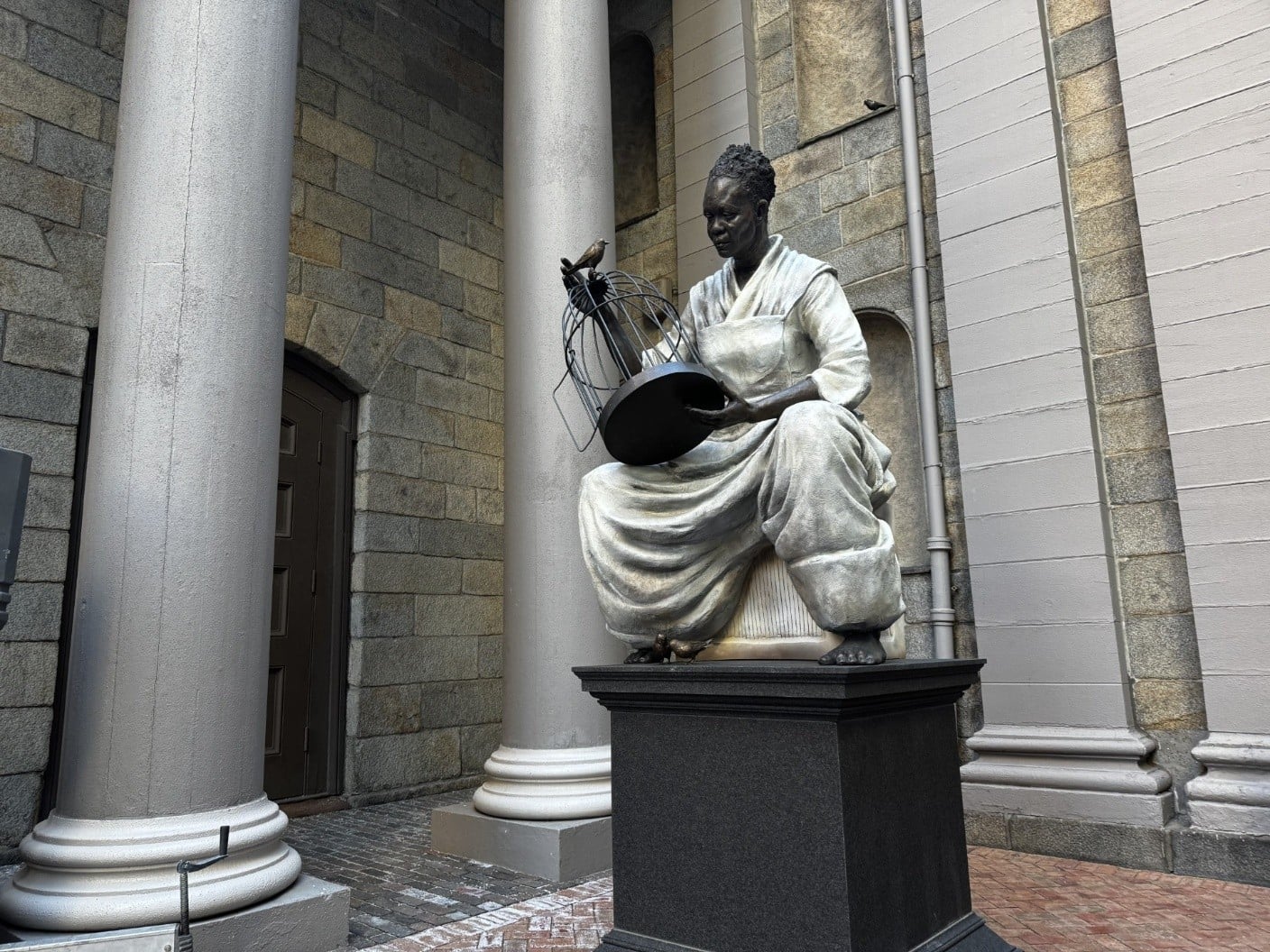
A short walk from the Old South Meeting House is King’s Chapel (1749). Home to one of New England’s oldest congregations, King’s Chapel stands on a site that has been occupied by churches since the 17th century. The neighboring graveyard, the King’s Chapel Burying Ground, is one of the oldest cemeteries in America. Its burials include John Winthrop, the first governor of Massachusetts, and William Dawes, one of the men who joined Paul Revere in his famous midnight ride. The recent addition of the Unbound memorial statue honoring the 219 children, women, and men who were enslaved by past ministers and members of the church is part of the congregation’s ongoing commitment to uncovering and acknowledging difficult history.
Park Street Church (1809) is located across from the Boston Common and next door to the Granary Burying Ground, the final resting place of notable historic figures including Paul Revere, Samuel Adams, and John Hancock. Many local and national improvement societies began at Park Street, including the American Education Society, the Boston NAACP, The Animal Rescue Society, and the American Temperance Society. Notable abolitionist William Lloyd Garrison gave his first public renunciation of slavery at Park Street Church. On July 4, 1831, Samuel Francis Smith and Lowell Mason debuted new lyrics for the patriotic anthem My Country, ‘Tis of Thee, also known as America.
An hour north of Boston is the last stop of this tour: the First Presbyterian Church, also known as Old South (1756). This unassuming church in the town of Newburyport is home to two historically significant elements. The first is an original church bell cast by Paul Revere, one of only four such bells still in existence which is still in use. The other, hidden away beneath the altar, is the tomb of George Whitefield, one of the defining ministers of the Great Awakening movement of the 18th century. Lucky visitors may be fortunate enough to have a deacon show them both.
The churches listed are just a few of the many historic congregations and structures in Eastern Massachusetts. Take note of days and hours when active churches are open for public visitation.
This blog post was updated in January 2026.